
With an area of just under 1.9 million hectares, arable farming in Lower Saxony accounts for around 40% of the total land area and is therefore the dominant land use.
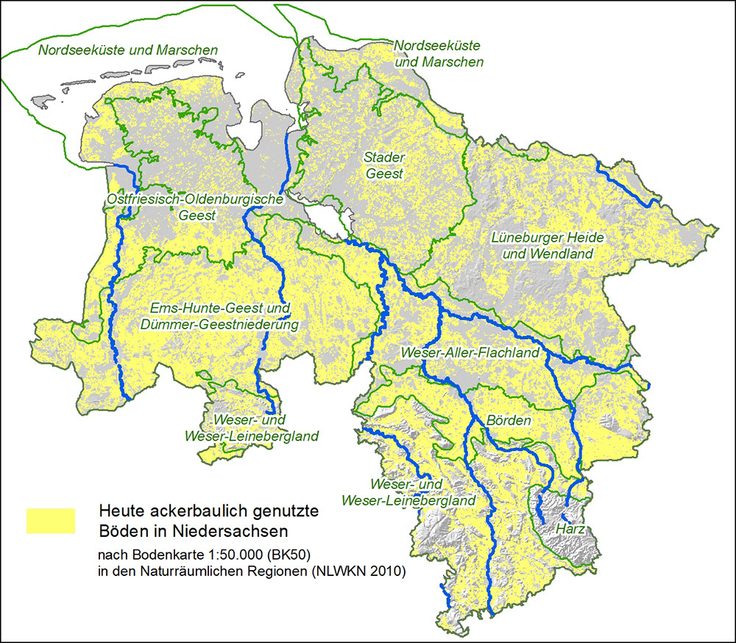
Image source:https://www.lbeg.niedersachsen.de/
Around half is used to grow cereals and oilseeds, with a further approx. 600 thousand hectares used for arable fodder production (including maize cultivation for biogas production). The cultivation of root crops (potatoes and sugar beet) accounts for a further 200 thousand hectares.
The crops grown differ from one part of the country to another: Livestock farming and potato cultivation are of great importance in the north and west of Lower Saxony. Over 50% of all potatoes in Germany are grown in Lower Saxony. The south of the state is increasingly characterized by cash crop farms and sugar beet cultivation in particular. The reason for this difference is the high-yielding soils south of the Mittelland Canal. These soils are characterized by high to very high soil fertility. The crops wheat and sugar beet achieve disproportionately high yields on these soils.
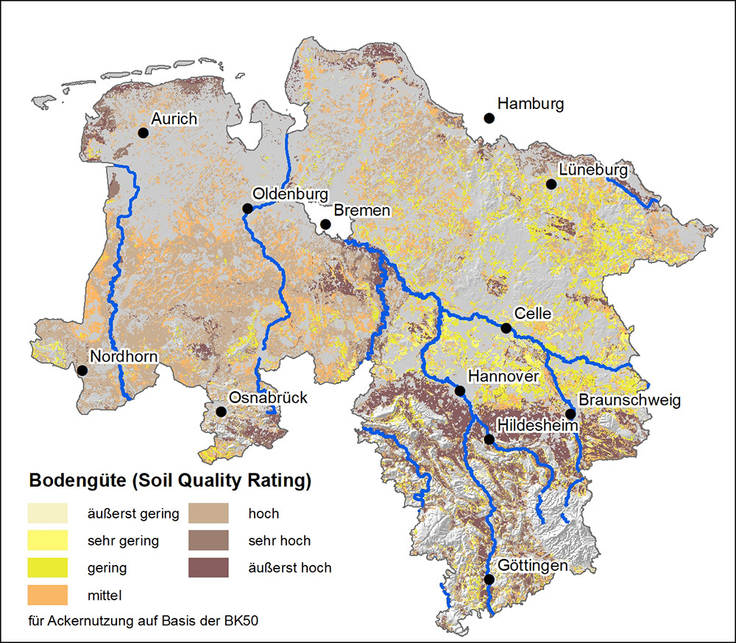
Image source:https://www.lbeg.niedersachsen.de/
Another special feature of Lower Saxony is its extensive arable farming on peatland.
Special ecological challenges therefore arise to varying degrees in different parts of the country:
In the western parts of the country, nutrient surpluses combined with one-sided crop rotations are the dominant problems. These primarily endanger ecosystem functions such as biodiversity and the regulation of water quality. In the potato regions, the groundwater lowering resulting from intensive irrigation is problematic, while in the intensive arable farming regions, long-term carbon storage and humus formation are challenging from an ecological perspective.
The challenges also vary on the economic side. While agricultural value creation in the processing regions in the west is generally achieved through livestock farming (supplemented by biogas production), arable farming, especially sugar beet cultivation, is the most important source of income in the south-east.
The regulatory framework for the use of fertilizers and pesticides is becoming increasingly important everywhere:
Be it the tightening of the Fertilizer Ordinance or the narrowing portfolio of active ingredients for chemical crop protection.
The Fertilizer Ordinance 2020 brought further tightening of existing regulations and limit values as well as increased record-keeping obligations for farmers. One of the main changes are the so-called “red areas”, which in Lower Saxony alone (as at the end of 2020) cover an area of around 796 thousand hectares, which corresponds to around 30% of the agricultural land in the entire state. On these areas, the calculated nitrogen fertilizer requirement must be reduced by 20%, and there is also a field-related upper limit for farm manure of 170 kg N/ha per year as well as stricter application restrictions.
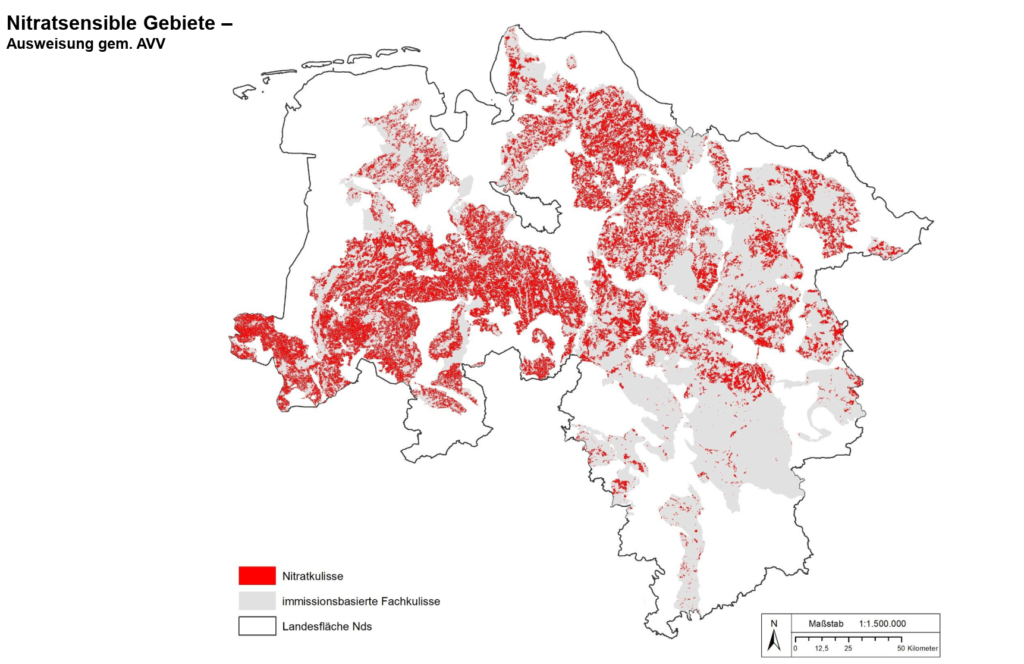
Image Source: https://www.ml.niedersachsen.de/
What do we expect from the results of the sub-project?
With regard to the challenges of transforming the food system a special feature of arable farming in Lower Saxony is the strong regional differentiation in crop rotations, greenhouse gas reduction potentials and nutrient balances. It can therefore be assumed that the regional differences within arable farming in Lower Saxony lead to specific requirements in order to achieve a sustainable food base that satisfies both social demands and plant cultivation requirements.